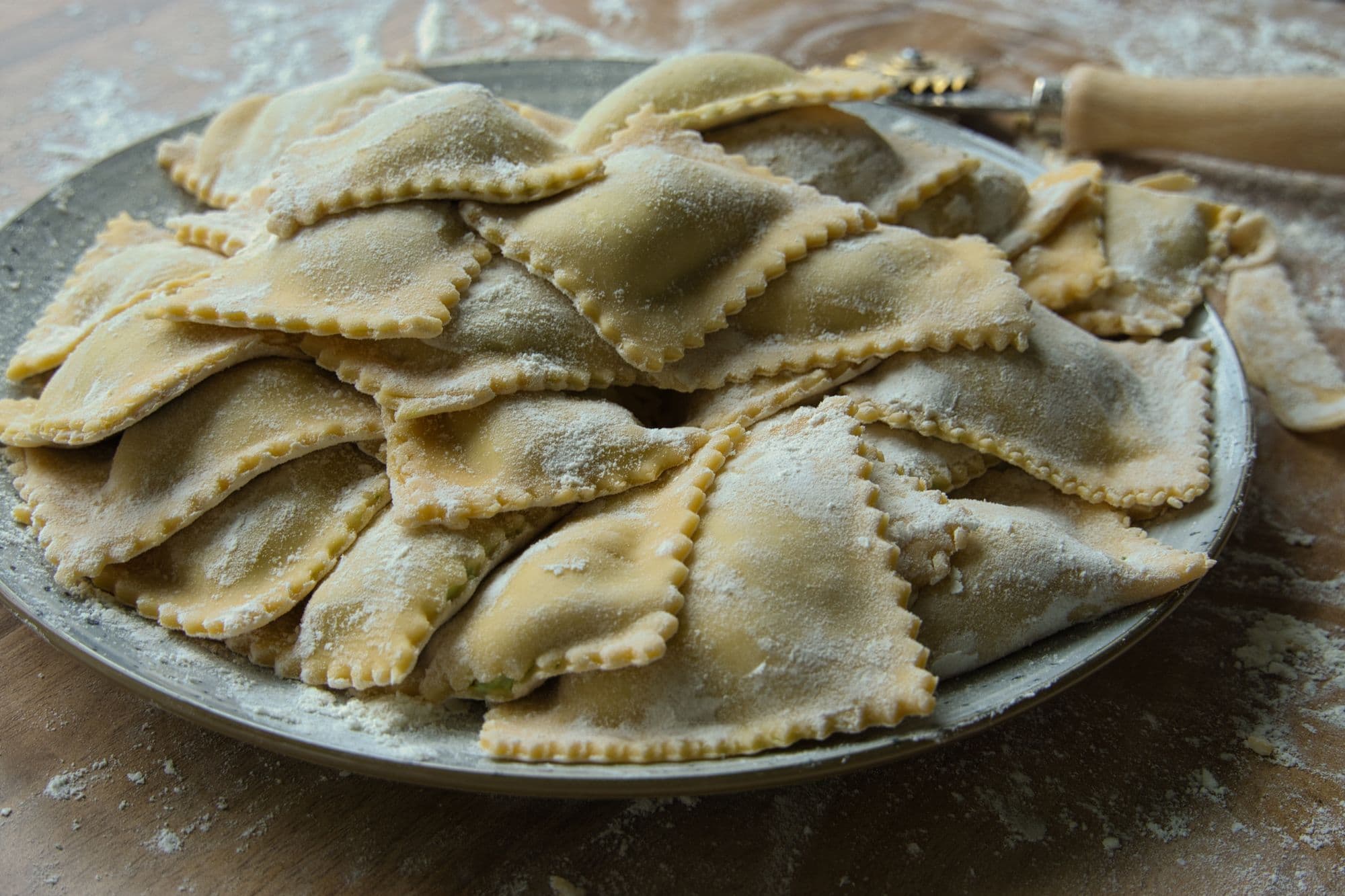
The pasta whose whole point is what's inside.
- Italian
- Ravioli
- Category
- Stuffed & Specialty
- Region
- Northern Italy
- Pastas
- 0 catalogued
The story
Ravioli are among the oldest stuffed pastas in the Italian record, documented by the 14th century in the letters of Francesco di Marco Datini, the famous merchant of Prato, and in the Venetian manuscript Libro per cuoco — both describing pockets of herbs, fresh cheese, and beaten egg simmered in broth. Boccaccio set them loose in the Decameron, tumbling down a mountain of grated Parmesan in the imaginary land of plenty. The name most likely traces to riavvolgere, "to wrap," though older theories tie it to rava (turnip) or an early soft cheese; the truth is unsettled. Tomato sauce came late, only after the fruit reached Italy in the 16th century, so the earliest ravioli were dressed simply, in broth or butter, and let the filling speak.
Shape & purpose
Two thin sheets of pasta pressed around a spoonful of filling and sealed at the edges — most often square, though rounds and half-moon mezzelune are just as traditional. The shape is a container first: the dough is rolled as thin as it will go so that the filling, not the wrapper, is what you taste. A clean seal is the whole engineering problem — too little filling and it's a pasta wafer, too much and it bursts in the pot.
Unlike an extruded shape built to grab sauce, ravioli arrive already complete: pasta and filling in a single bite. Sauces are chosen to flatter what's inside rather than to be trapped by texture, which is why the classics stay light — melted butter and sage, a few spoonfuls of brodo, a restrained tomato. The richer the filling, the quieter the sauce.
Sauce pairings
- 01Burro e salviaButter and sage, the default dress for a ricotta-and-spinach filling.
- 02In brodoFloated in a clear capon or beef broth, the oldest way to serve them.
- 03Di zuccaPumpkin and crushed amaretti, a northern Christmas Eve filling.
- 04Al pomodoroA light tomato for meat or cheese fillings; keep it restrained.
Cooking technique
Ravioli want a gentle boil, never a hard rolling one — violent water tears the seams. Give them a wide pot with room to move; they're done about a minute after they float, usually three to four minutes for fresh. Lift them out with a spider rather than tipping them into a colander, which crushes them. Dress immediately and lightly — they don't need to finish in the pan the way a sturdy dried shape does.
No one’s shelved a ravioli yet — add the one you’ve cooked.